 Earth and Moon Viewer: Credits
Earth and Moon Viewer: Credits
Earth and Moon Viewer: Credits
The Earth Viewer was first implemented by John Walker in December 1994. Most of the software that generates the various views of the Earth was adapted from Home Planet for Windows. See the details for additional implementation information. It was extended to allow viewing the Moon as well as the Earth in October 1996.
The satellite tracking code is based upon the N3EMO Orbit Simulator:
            N3EMO Orbit Simulator routines  v3.7

   Copyright © 1986,1987,1988,1989,1990 Robert W. Berger N3EMO
   May be freely distributed, provided this notice remains intact.
The GIF output file generation is based upon the
ppmtogif module of
Jef
Poskanzer's pbmplus toolkit, of which many
other components were used in creating the images you see here.
The Netpbm toolkit is a much-extended
version of pbmplus; Earth and Moon Viewer was
developed using only pbmplus components.
   ppmtogif.c - read a portable pixmap and produce a GIF file

   Based on GIFENCOD by David Rowley [mgardi@watdscu.waterloo.edu].
   Lempel-Ziv compression based on "compress".

   Modified by Marcel Wijkstra [wijkstra@fwi.uva.nl]

   Copyright © 1989 by Jef Poskanzer.

   Permission to use, copy, modify, and distribute this software and its
   documentation for any purpose and without fee is hereby granted, provided
   that the above copyright notice appear in all copies and that both that
   copyright notice and this permission notice appear in supporting
   documentation.  This software is provided "as is" without express or
   implied warranty.

   The Graphics Interchange Format© is the Copyright property of
   CompuServe Incorporated.  GIF(sm) is a Service Mark property of
   CompuServe Incorporated.
JPEG output file generation is based upon the tookit developed by the Independent JPEG Group. Their contribution of industrial-strength JPEG support to the public domain has enabled the development of innumerable software tools, Earth and Moon Viewer among them.
Steven Grimm's
uncgi
made the task of processing form arguments in the server immeasurably
easier.
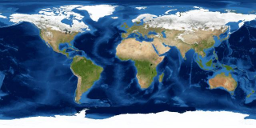 The default databases for generating images of the Earth are the
NASA
Blue Marble
Next Generation cloudless Earth and
Black Marble
night lights images. Blue Marble images include global cloudless
Earth data from the MODIS instrument on the
Terra spacecraft, combined
with global topography and bathymetry data, with a spatial
resolution of 500 metres per pixel, resulting in images of
86400×43200 pixels. Twelve images are included in the
data set, containing representative ice and snow cover and
vegetation colour for each month of the year. The image is
automatically selected based on the month being displayed.
(Due to disc and memory space constraints on the Fourmilab
server, the monthly images used by Earth and Moon Viewer are reduced in
resolution to one kilometre per pixel, or 43200×21600
pixels.)
The night portion of the Earth uses the
Black Marble v2012 imagery
with a resolution of 750 metres per pixel, or 54000×27000
pixels, derived from cloudless Earth images returned by the
Suomi NPP spacecraft.
The default databases for generating images of the Earth are the
NASA
Blue Marble
Next Generation cloudless Earth and
Black Marble
night lights images. Blue Marble images include global cloudless
Earth data from the MODIS instrument on the
Terra spacecraft, combined
with global topography and bathymetry data, with a spatial
resolution of 500 metres per pixel, resulting in images of
86400×43200 pixels. Twelve images are included in the
data set, containing representative ice and snow cover and
vegetation colour for each month of the year. The image is
automatically selected based on the month being displayed.
(Due to disc and memory space constraints on the Fourmilab
server, the monthly images used by Earth and Moon Viewer are reduced in
resolution to one kilometre per pixel, or 43200×21600
pixels.)
The night portion of the Earth uses the
Black Marble v2012 imagery
with a resolution of 750 metres per pixel, or 54000×27000
pixels, derived from cloudless Earth images returned by the
Suomi NPP spacecraft.
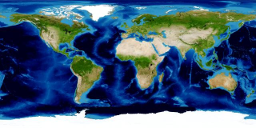 A higher resolution alternative to the Blue Marble Monthly
images is the basic
NASA
Blue Marble
and
Black Marble
night lights images. This data set is based upon the same
sources as the Blue Marble Monthlies, but provides a
a single image representing the Earth with only year-round
ice and snow cover. Earth and Moon Viewer makes this image
available at its full resolution, 86400×43200 pixels, or
500 metres per pixel, so more detail will be visible in
close-up views of the day side of Earth than with the Blue
Marble Monthlies.
A higher resolution alternative to the Blue Marble Monthly
images is the basic
NASA
Blue Marble
and
Black Marble
night lights images. This data set is based upon the same
sources as the Blue Marble Monthlies, but provides a
a single image representing the Earth with only year-round
ice and snow cover. Earth and Moon Viewer makes this image
available at its full resolution, 86400×43200 pixels, or
500 metres per pixel, so more detail will be visible in
close-up views of the day side of Earth than with the Blue
Marble Monthlies.
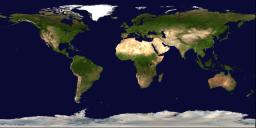 The NASA
Visible Earth
image was assembled from imagery acquired by the MODIS
instrument on the
Terra
spacecraft. Lights on the night side were imaged from
Defense
Meteorological Satellite Program spacecraft. Low resolution
image requests use a day/night database of 8000×4000
pixels, providing resolution of about 5 kilometres per pixel.
When you zoom in for close-up views, Earth and Moon Viewer
automatically switches to a
database with 1 km/pixel
resolution (43200×21600 pixels). There is no night lights
database with comparable resolution, so close-ups of the Earth's
night side will appear coarse.
The NASA
Visible Earth
image was assembled from imagery acquired by the MODIS
instrument on the
Terra
spacecraft. Lights on the night side were imaged from
Defense
Meteorological Satellite Program spacecraft. Low resolution
image requests use a day/night database of 8000×4000
pixels, providing resolution of about 5 kilometres per pixel.
When you zoom in for close-up views, Earth and Moon Viewer
automatically switches to a
database with 1 km/pixel
resolution (43200×21600 pixels). There is no night lights
database with comparable resolution, so close-ups of the Earth's
night side will appear coarse.
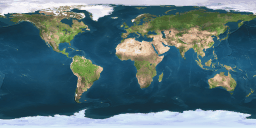 The Living Earth®
image is a composite of Earth satellite imagery developed by
The Living Earth, Inc.. This image
is © Copyright 1996 The Living Earth, Inc./Earth Imaging, All
Rights Reserved and is used here by permission of the publisher.
For additional information about this and other images and products,
contact The Living Earth via E-mail to
contact@livingearth.com.
The Living Earth®
image is a composite of Earth satellite imagery developed by
The Living Earth, Inc.. This image
is © Copyright 1996 The Living Earth, Inc./Earth Imaging, All
Rights Reserved and is used here by permission of the publisher.
For additional information about this and other images and products,
contact The Living Earth via E-mail to
contact@livingearth.com.
The original images of the Earth by day and night are
8640×4320 24-bit pixels: more than 110 megabytes each. To
permit interactive access in Earth Viewer, the images were
compressed to reduce the number of colours in the day side image
to 1024 and the night side to 64. This reduces the image
database to a large, but manageable, 74.6 megabytes. The
ultimate resolution of the database is about 4.6 kilometres per
pixel. The original images and products based upon them have
additional fine detail which had to be sacrificed to allow quick
response to Earth Viewer requests; please contact The Living
Earth for further details and examples of the full-colour
images.
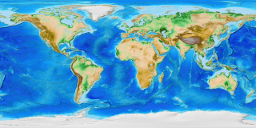 The high-resolution topographic map is based upon the
ETOPO1 Global Relief Model
developed by the
National Centers for Environmenal
Information
operated by the United States
Department of Commerce,
National Oceanic and Atmospheric Administration.
The image has resolution of one minute of arc, or one nautical mile,
and is thus 21600×10800 colour pixels. Reduced resolution
versions of the image are used for wide area renderings, automatically
switching to the full resolution image for close-ups. Permanent ice
cover on Antarctica, Greenland, and arctic islands are shown, but
sea ice is not, showing the topography of the ocean floor instead.
The high-resolution topographic map is based upon the
ETOPO1 Global Relief Model
developed by the
National Centers for Environmenal
Information
operated by the United States
Department of Commerce,
National Oceanic and Atmospheric Administration.
The image has resolution of one minute of arc, or one nautical mile,
and is thus 21600×10800 colour pixels. Reduced resolution
versions of the image are used for wide area renderings, automatically
switching to the full resolution image for close-ups. Permanent ice
cover on Antarctica, Greenland, and arctic islands are shown, but
sea ice is not, showing the topography of the ocean floor instead.
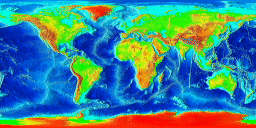 The global topographic map
was developed by the
Marine Geology and Geophysics Division
of the National Geophysical Data Center
operated by the United States
Department of Commerce,
National Oceanic and Atmospheric Administration.
The colour resolution in the original image has been reduced to
allow rapid generation of day and night hemispheres. The
topographic map is derived from the ETOPO2 global elevation
database, which provides 2 minute of arc (2 nautical mile)
resolution for most of the Earth.
The global topographic map
was developed by the
Marine Geology and Geophysics Division
of the National Geophysical Data Center
operated by the United States
Department of Commerce,
National Oceanic and Atmospheric Administration.
The colour resolution in the original image has been reduced to
allow rapid generation of day and night hemispheres. The
topographic map is derived from the ETOPO2 global elevation
database, which provides 2 minute of arc (2 nautical mile)
resolution for most of the Earth.
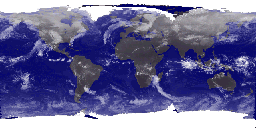 The cloud cover, colour weather, and water vapour density
images are generated on the fly, every three hours, from the
whole-Earth
weather
satellite composites made available by
the University
of Wisconsin-Madison Space Science and
Engineering Center.
I take this image,
then transform it from the Mollweide projection in which it is
published to the cylindrical projection expected by Earth Viewer's image
generator (thanks to code from the
GCTPc package.
The images are postprocessed for use by Earth and Moon Viewer
using tools from the
The cloud cover, colour weather, and water vapour density
images are generated on the fly, every three hours, from the
whole-Earth
weather
satellite composites made available by
the University
of Wisconsin-Madison Space Science and
Engineering Center.
I take this image,
then transform it from the Mollweide projection in which it is
published to the cylindrical projection expected by Earth Viewer's image
generator (thanks to code from the
GCTPc package.
The images are postprocessed for use by Earth and Moon Viewer
using tools from the pbmplus package described
above.
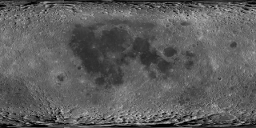 The default database for generating images of the Moon is the
LRO LROC-WAC Global Mosaic 100m
produced by the Arizona State University
Lunar
Reconnaissance Orbiter Camera Team from imagery returned by
the NASA
Lunar Reconnaissance Orbiter
spacecraft from orbit around the Moon. The image database consists of
109164×54582 grey scale pixels in a cylindrical projection
compiled into a mosaic from imagery collected between November
2009 and February 2011, and provides 100 metre per pixel
resolution for the entire lunar surface. The 5.6 gigabyte
image is sub-sampled at several intermediate resolutions to
improve performance when generating images where the full resolution
is not required, while using the 100 metre per pixel data for
views as close as one kilometre from the surface.
The default database for generating images of the Moon is the
LRO LROC-WAC Global Mosaic 100m
produced by the Arizona State University
Lunar
Reconnaissance Orbiter Camera Team from imagery returned by
the NASA
Lunar Reconnaissance Orbiter
spacecraft from orbit around the Moon. The image database consists of
109164×54582 grey scale pixels in a cylindrical projection
compiled into a mosaic from imagery collected between November
2009 and February 2011, and provides 100 metre per pixel
resolution for the entire lunar surface. The 5.6 gigabyte
image is sub-sampled at several intermediate resolutions to
improve performance when generating images where the full resolution
is not required, while using the 100 metre per pixel data for
views as close as one kilometre from the surface.
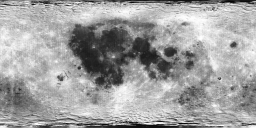 Images of the Moon can also be generated based on a 1440×720
lunar
relief and albedo databases created by the
U.S.
Geological Survey
Flagstaff Field Center
from imagery returned by the
BMDO/NASA
Clementine
lunar orbiter. Albedo (reflectivity) is the intrinsic
brightness of the terrain as opposed to its appearance from
Earth or space, which depends also upon the angle at which the
Sun illuminates the Moon at a given time. Except for
high-latitude and polar regions, which are always illuminated
obliquely due to the low inclination of the Moon's orbit with
respect to the ecliptic, the albedo map represents the
appearance of the Moon when the Sun is at the meridian for each
longitudinal strip of the image.
Images of the Moon can also be generated based on a 1440×720
lunar
relief and albedo databases created by the
U.S.
Geological Survey
Flagstaff Field Center
from imagery returned by the
BMDO/NASA
Clementine
lunar orbiter. Albedo (reflectivity) is the intrinsic
brightness of the terrain as opposed to its appearance from
Earth or space, which depends also upon the angle at which the
Sun illuminates the Moon at a given time. Except for
high-latitude and polar regions, which are always illuminated
obliquely due to the low inclination of the Moon's orbit with
respect to the ecliptic, the albedo map represents the
appearance of the Moon when the Sun is at the meridian for each
longitudinal strip of the image.
Using an albedo map and ignoring the effects of elevation and sun
angle leads to a washed-out appearance near
the terminator (boundary between day and night), especially in the
lunar highlands and most of the far side where there is little
intrinsic albedo difference and most of observed detail results from
terrain features. The relief map shows terrain but neglects albedo;
choose whichever produces the most useful image for your purpose.
The algorithms to calculate the position of the Sun and Moon are given in:
Meeus, Jean. Astronomical Algorithms. Richmond: Willmann-Bell, 1998. ISBN 978-0-943396-61-3.
Return to Earth and Moon Viewer