Robert Heinlein's 1950 movie collaboration with George Pal,
Destination Moon, is rightly considered
one of the timeless classics of film science fiction, winning an Oscar
for Best Special Effects. On the other hand, his 1953 effort with Richard
Talmadge, Project Moonbase, is largely
forgotten, and deservedly so. Set in 1970, it features some of the Heinlein
view of the future which would come to characterise his later work: the
president of the United States is a woman, as is the first person to orbit the Earth
and commander of this Moon mission, Colonel Briteis (don't
pronounce it “bright-eyes” in her presence, unless you
outrank her!), who owes her selection for the mission in part to
public relations motivated reverse-discrimination against men.
Unlike Destination Moon, the special effects here are—how
shall I put it?—cheesy. There are delightful cordless
telephones which look just like fifties Ma Bell gear with little loop
antennas coming out of the desk set and receiver, the obligatory V2
camera footage from White Sands, spinning tape reels and blinking
lights, a page-flipping
“digital calendar”
which gets it right for 1970, intrepid spacemen and -women
sweating and straining against G forces which don't seem to deform the
cots they're lying on, and Earth to Moon communication without the
delay due to the
finite speed of light.
The scientist on the Moon flight who is impersonated by a Commie
double bent on sabotage is named “Dr. Wernher”.
The apogee of tackiness in the special effects is when a supply ship
comes in to land at the newly-established Moon base. Col. Briteis and
her fellow crewmember and soon to be betrothed Maj. Moore sit in
front of a screen and twiddle knobs to guide the ship as it, for some
inexplicable reason, flies back and forth with a rocket plume which
looks remarkably like the flame from a welding torch. Then they steer
it in for a landing, “by hand” via remote control, and
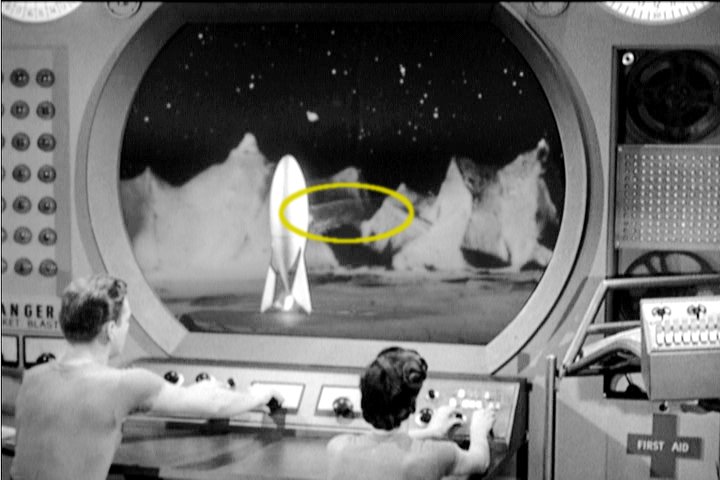
things get downright hilarious. Below is a video clip of this
scene. Take a look and see if you can
spot the delightful means by which the Moon landing was effected.
When I say the supply craft was landed “by hand”, I really
meant it! If you look at the video closely, you can see that when the
rocket is making its final approach to the Moon, it's being held
around the middle by somebody's hand (probably wearing a glove which
was not sufficiently dark for the bright movie lights), which sets it
down on the lunar surface, then gently tips it down to the
horizontal. This scene was obviously made by optically printing
separate shots of the background and the rocket (and hand), so you can
only see the hand when it's against a background darker than the hand
itself. (The same effect shows up during the descent of the rocket,
where stars in the background show through darker portions of the ship
but, hey, maybe it's made of
transparent
aluminium.)
Now, after he “got better” and outgrew his youthful flirtation with
socialist nostrums, Heinlein was pretty consistently
in the libertarian/individualist camp, championing individual liberty, self-reliance,
minimal government, and the
“invisible hand”
of the market. Here we have another example, from Hollywood of all
places, that an invisible hand would have been a great improvement
over top-down control!
Other details not to miss in this movie are that USSF officers wear
sidearms in space, even on a lunar mission with a crew of three (not a
bad idea, perhaps, in light of the recent
“Desperate
Astronauts” episode!), and that their space station includes
cabins labelled “Chaplain” and “Salvation
Army”.
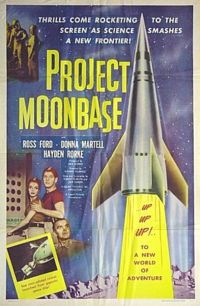 Robert Heinlein's 1950 movie collaboration with George Pal,
Destination Moon, is rightly considered
one of the timeless classics of film science fiction, winning an Oscar
for Best Special Effects. On the other hand, his 1953 effort with Richard
Talmadge, Project Moonbase, is largely
forgotten, and deservedly so. Set in 1970, it features some of the Heinlein
view of the future which would come to characterise his later work: the
president of the United States is a woman, as is the first person to orbit the Earth
and commander of this Moon mission, Colonel Briteis (don't
pronounce it “bright-eyes” in her presence, unless you
outrank her!), who owes her selection for the mission in part to
public relations motivated reverse-discrimination against men.
Robert Heinlein's 1950 movie collaboration with George Pal,
Destination Moon, is rightly considered
one of the timeless classics of film science fiction, winning an Oscar
for Best Special Effects. On the other hand, his 1953 effort with Richard
Talmadge, Project Moonbase, is largely
forgotten, and deservedly so. Set in 1970, it features some of the Heinlein
view of the future which would come to characterise his later work: the
president of the United States is a woman, as is the first person to orbit the Earth
and commander of this Moon mission, Colonel Briteis (don't
pronounce it “bright-eyes” in her presence, unless you
outrank her!), who owes her selection for the mission in part to
public relations motivated reverse-discrimination against men.
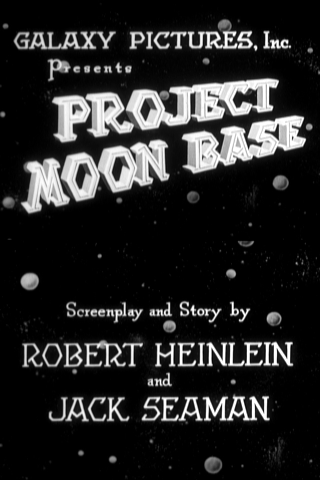 Unlike Destination Moon, the special effects here are—how
shall I put it?—cheesy. There are delightful cordless
telephones which look just like fifties Ma Bell gear with little loop
antennas coming out of the desk set and receiver, the obligatory V2
camera footage from White Sands, spinning tape reels and blinking
lights, a page-flipping
“
Unlike Destination Moon, the special effects here are—how
shall I put it?—cheesy. There are delightful cordless
telephones which look just like fifties Ma Bell gear with little loop
antennas coming out of the desk set and receiver, the obligatory V2
camera footage from White Sands, spinning tape reels and blinking
lights, a page-flipping
“